
Stripe Drift: When Billing and Product Access Fall Out of Sync
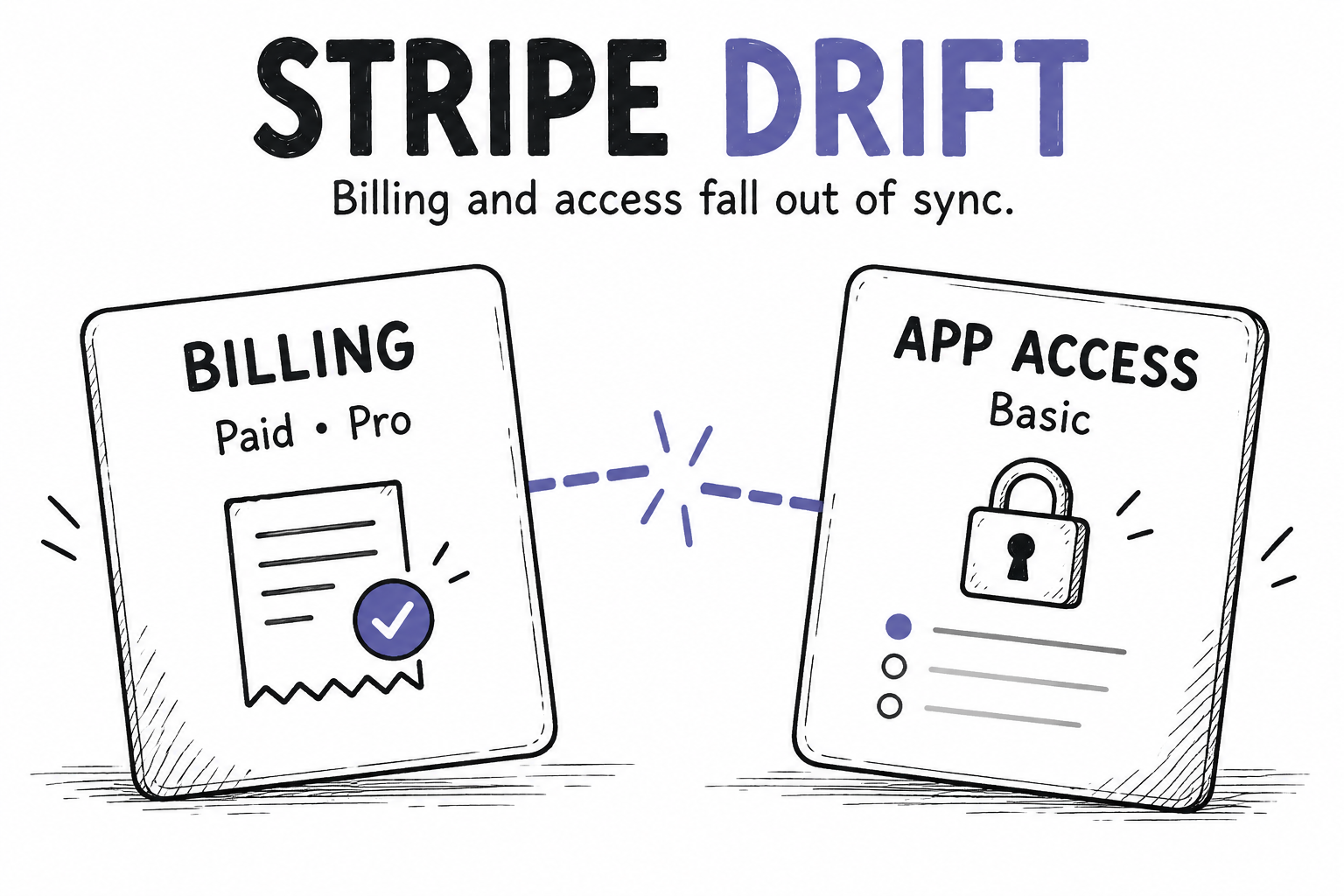
Your billing system and your application need to agree on what a customer has purchased. When they stop agreeing, customers can pay for features they cannot use, canceled accounts can keep access, and support teams can spend hours deciding which record to trust.
That mismatch is often called Stripe drift: Stripe’s subscription data and the subscription state your application uses have fallen out of sync. It can begin with a missed update or an incorrect plan mapping and persist long after the original error has disappeared from your logs.
Understanding drift means looking at more than whether a payment succeeded. You need to understand how billing changes reach your application, how those changes affect access, and how you recover when an update goes wrong. A subscription library such as Subscrio helps make those responsibilities explicit, while subscription synchronization provides a way to bring stale records back into agreement.
What actually drifts?
Stripe holds billing information: the customer’s subscription, its prices, its status, and its billing dates. Your application needs to turn that information into decisions about what the customer can do.
Those permissions are called entitlements. They might determine whether an account can export reports, invite another team member, use an API, or access a particular feature. Some entitlements are simple yes-or-no permissions; others have limits.
Between the Stripe subscription and the final access decision, your application may maintain its own subscription record, map a Stripe price to an internal plan, apply an account-specific agreement, and cache the result. Each step introduces a place where an old or incorrect value can survive.
Drift can therefore take several forms:
| Mismatch | What it means for the customer or business |
|---|---|
| Stripe records an upgrade, but the application retains the old plan | The customer pays more without receiving the new features or limits |
| Access remains after a subscription has ended and the access policy requires revocation | The business continues providing a service without the corresponding subscription |
| A renewed billing period never reaches the application | The application may treat an ongoing subscription as expired |
| A Stripe price maps to the wrong internal plan | Billing can be correct while the customer consistently receives the wrong access |
| The subscription record is correct, but an access cache is stale | Different parts of the application can disagree about the same customer |
Not every difference is an error. A customer may have a grace period, a negotiated feature override, or access through the end of a paid period after requesting cancellation. The correct comparison is between the access your policy promises and the access your application actually provides.
The damage goes beyond a wrong database field
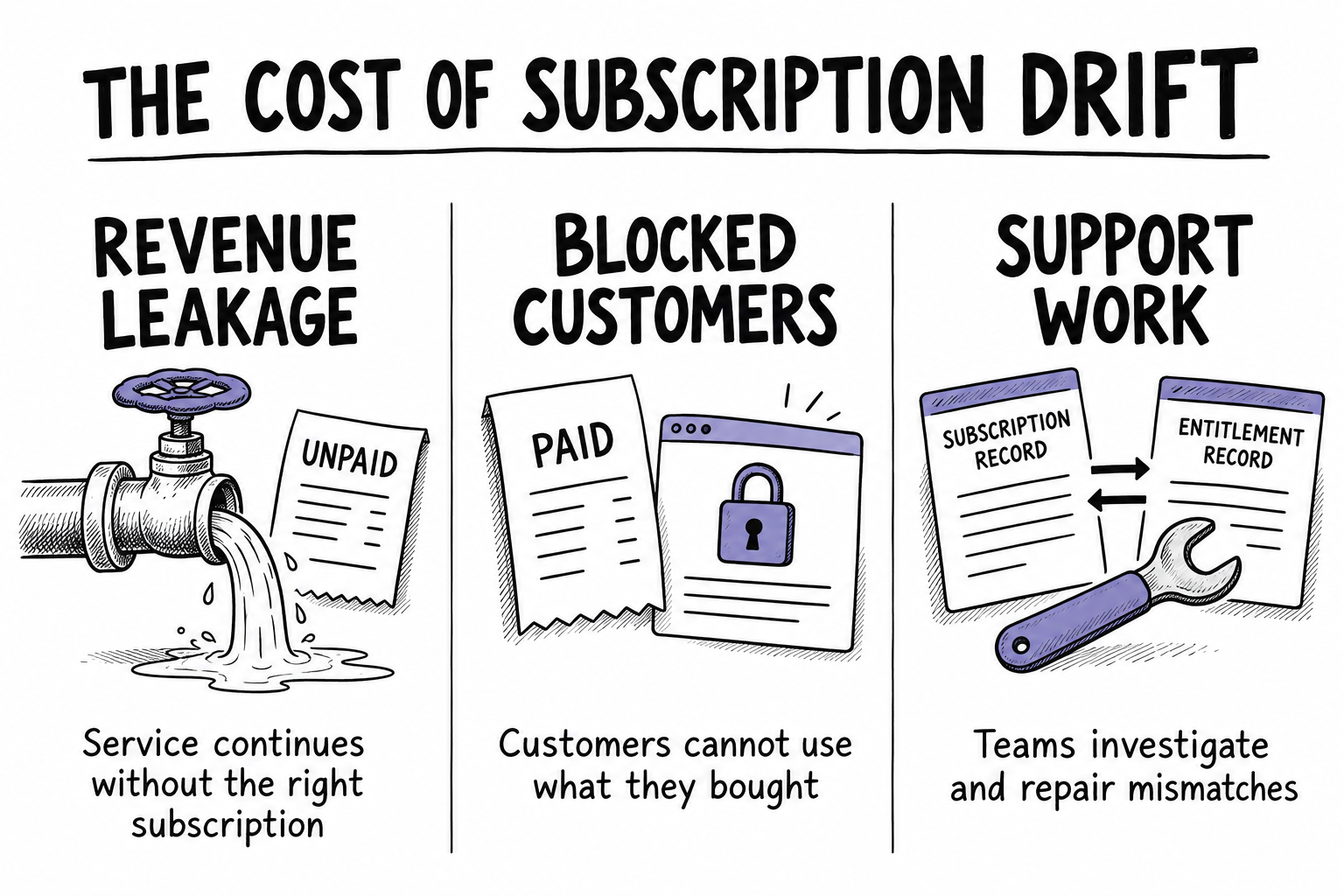
Revenue leakage and avoidable service costs
When access continues beyond the agreed entitlement, a business can keep paying for compute, storage, third-party APIs, or support without the expected subscription revenue. Incorrect limits can also let an account consume more than its plan includes.
The amount depends on the product and the duration of the mismatch. A feature that costs little to serve has different consequences from unrestricted processing through a paid external API. Either way, the billing dashboard alone may not reveal the problem: it records billing activity, while the excess service is happening inside the application.
Paying customers lose confidence
A customer who pays for an upgrade expects the product to recognize it. An upgrade prompt immediately after payment makes the business look unreliable, even if the payment integration itself worked correctly.
Blocked access can interrupt work, delay adoption of a paid feature, and lead to refund requests or cancellation. A manual correction may restore access, but the customer has already had to explain why they should receive something they bought.
Support becomes a subscription repair service
Drift pushes engineering decisions into support tickets. Someone compares Stripe with the application database, checks which plan should apply, and edits a record to get the customer moving again.
That work is expensive to repeat. It also creates another source of inconsistency if the correction bypasses the normal subscription rules or is overwritten by a later event. Without a clear way to reconcile the systems, the same account can return to support with the same problem.
Where Stripe drift comes from
- Missed or failed updates: a webhook arrives, but the job or database write never completes.
- Duplicate or delayed events: repeated processing or an older update overwrites the intended state. Stripe documents these delivery behaviors.
- Incorrect plan mappings: a Stripe price points to the wrong internal plan, or a new price has no mapping.
- Scattered access rules: different parts of the application make different assumptions about what each plan allows.
- Stale records and caches: billing changes, restored backups, or outdated access decisions leave the app behind.
A healthy webhook endpoint does not prove that every subscription and access decision is correct.
Prevent drift from becoming a permanent condition
Reliable subscription handling needs both timely updates and a way to recover from missed or incorrect ones.
For incoming updates, verify event signatures, durably accept the work, and make failures retryable. Processing the same event again should not repeat a one-time benefit or corrupt a subscription. Concurrent or delayed updates should not allow old state to overwrite a newer decision.
Then add reconciliation: compare the current billing state with the subscription state your application holds and correct unintended differences. This catches problems that remain after the original event-processing attempt has finished or failed.
Reconciliation needs to understand ownership. Stripe supplies billing facts; your application supplies policies such as grace periods and negotiated entitlements. Synchronizing subscriptions should preserve those deliberate policies rather than treat every difference as something to erase.
The distinction matters because a system can be perfectly synchronized and still enforce the wrong policy. Reliable data and consistent access decisions are both necessary.
How Subscrio helps
Subscrio gives the application a shared subscription and entitlement model. Plans define feature values, subscriptions can carry overrides, and application code can ask for the feature or limit it needs instead of repeating assumptions about plan names.
That creates a consistent place to express what a subscription allows. An upgrade changes the customer’s subscription state; the application resolves access through the same feature rules. Developers maintain the connection between billing and that model rather than rebuilding access policy independently in each part of the product.
Subscrio’s Stripe integration connects Stripe billing information to local subscription records, including the mapping between Stripe prices and Subscrio billing cycles. The admin app’s Sync subscriptions feature adds an explicit way to refresh those records from Stripe.
Run a sync when you need to recover
You can run Sync subscriptions manually when investigating a mismatch or after an interruption in subscription processing. It brings supported subscription data back in line with current Stripe information so you can check access against an up-to-date subscription record.
This gives administrators a defined recovery action instead of making direct database edits the normal response to a billing discrepancy.
Schedule synchronization to catch missed updates
You can also schedule Sync subscriptions to run regularly. Webhooks handle changes as they happen; scheduled synchronization provides recurring opportunities to correct records that did not receive a successful update.
Choose the interval according to how quickly your business needs to detect and correct a mismatch. More frequent synchronization reduces the time between checks, but it does not guarantee immediate correction: a run still needs to complete successfully, and the application’s access decisions need to use the refreshed data.
Keep the remaining responsibilities clear
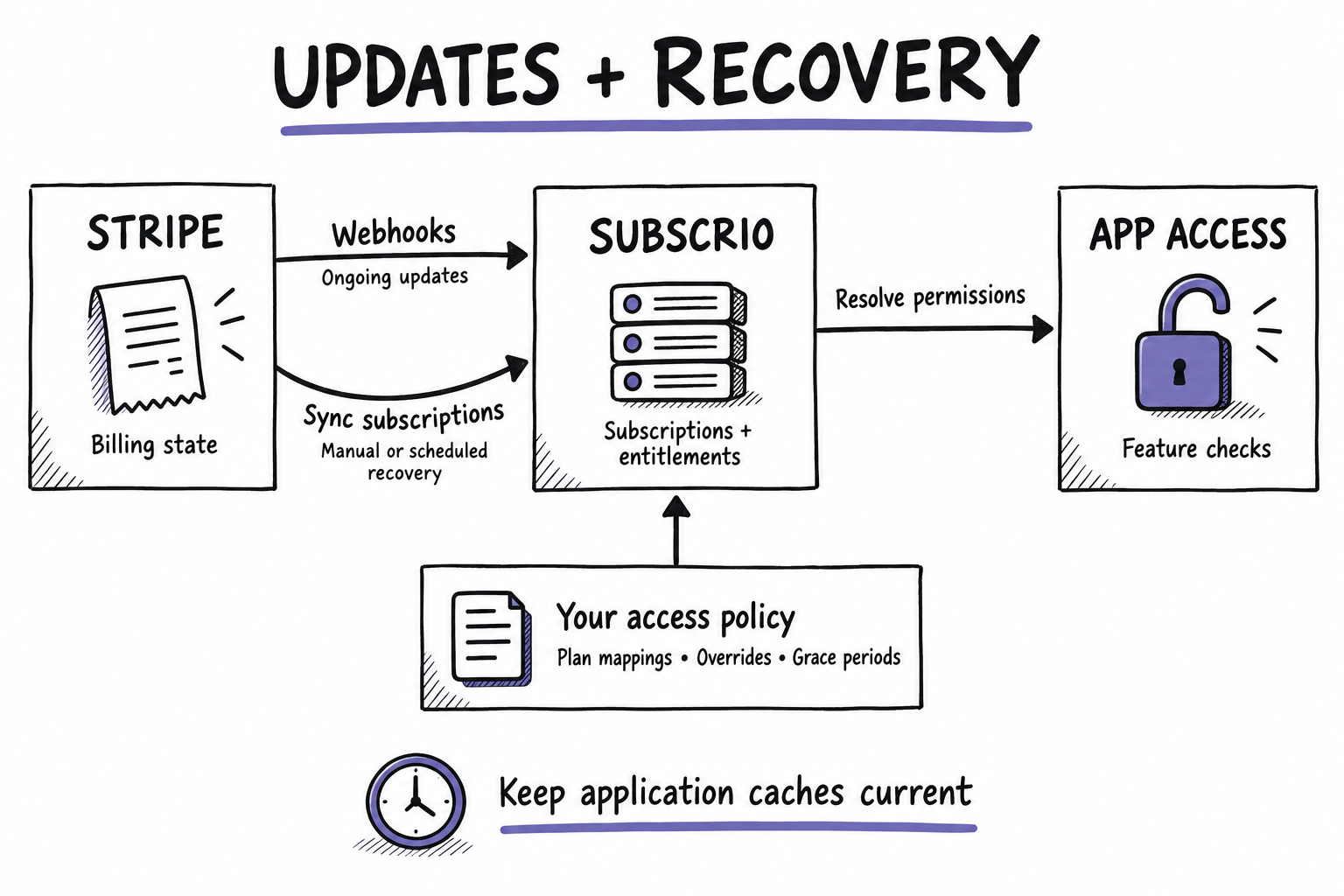
Webhooks keep records current; synchronization provides recovery. Access policy and application cache handling remain part of the design.
Synchronization cannot infer the right plan from an incorrect price mapping. It cannot correct an access check that ignores the entitlement model, and application caches still need an appropriate refresh strategy.
Stripe also offers native Entitlements, which maps product features to customers and exposes entitlement changes. Whichever approach you choose, the application must consistently enforce the resulting permissions and have a recovery path when its stored state becomes stale.
For teams using Subscrio, the combination is straightforward: maintain the billing mappings, use a shared entitlement model for access, process subscription events reliably, and run synchronization as a routine recovery mechanism. Our Stripe renewal integration guide covers the event-driven integration in C# and TypeScript.
Treat subscription accuracy as something you maintain
Stripe drift can remain invisible until a customer complains or someone notices service being provided under the wrong terms. By that point, the cost may already include lost revenue, interrupted work, and repeated support effort.
A dependable subscription system makes those discrepancies easier to prevent, detect, and repair. Consistent entitlement rules reduce conflicting access decisions. Reliable event processing keeps subscriptions current. Manual and scheduled synchronization give the business a way to recover when those updates fall short.
The practical question is simple: if one subscription update fails today, how will your application become correct again—and how long will your customer have to wait?